







IJRAR Peer-Reviewed (Refereed) Journal as Per New UGC Rules.
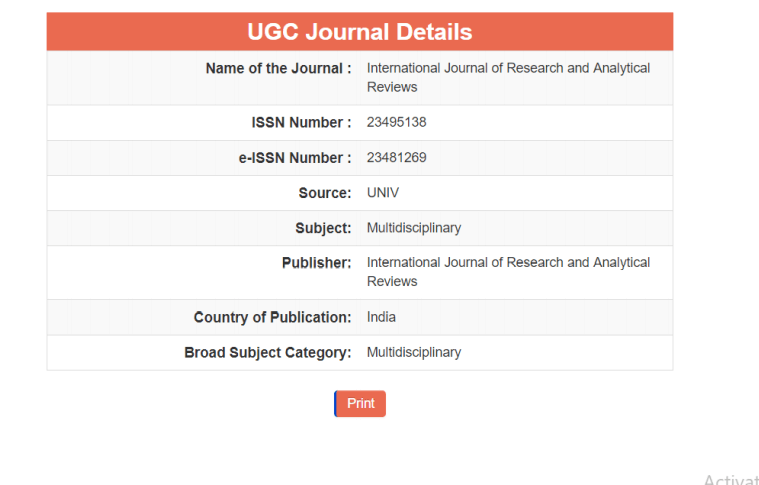
ISSN Approved Journal No: E-ISSN 2348-1269, P- ISSN 2349-5138
Journal ESTD Year: 2014 | CrossRef DOI
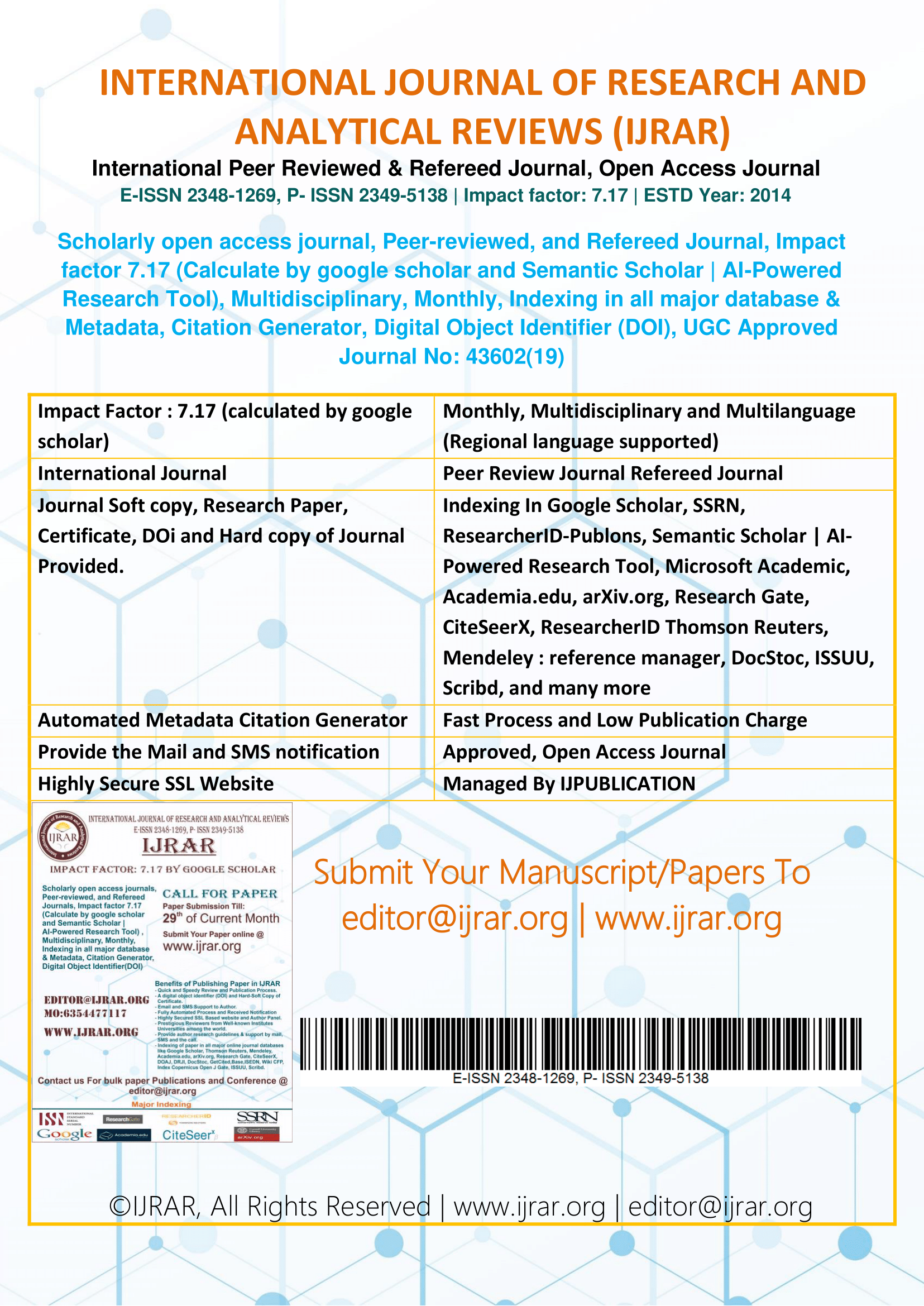
Read all new guidelines related publication before submission or publication. Scholarly open access , Peer-reviewed, and Refereed, Impact Factor: 7.17, AI-Powered Research Tool , Multidisciplinary, Monthly, Indexing in all major database & Metadata, Citation Generator, Digital Object Identifier(DOI), UGC Approved Journal No: 43602(19)
The INTERNATIONAL JOURNAL OF RESEARCH AND ANALYTICAL REVIEWS (IJRAR) aims to explore advances in research pertaining to applied, theoretical and experimental Technological studies. The goal is to promote scientific information interchange between researchers, developers, engineers, students, and practitioners working in and around the world.
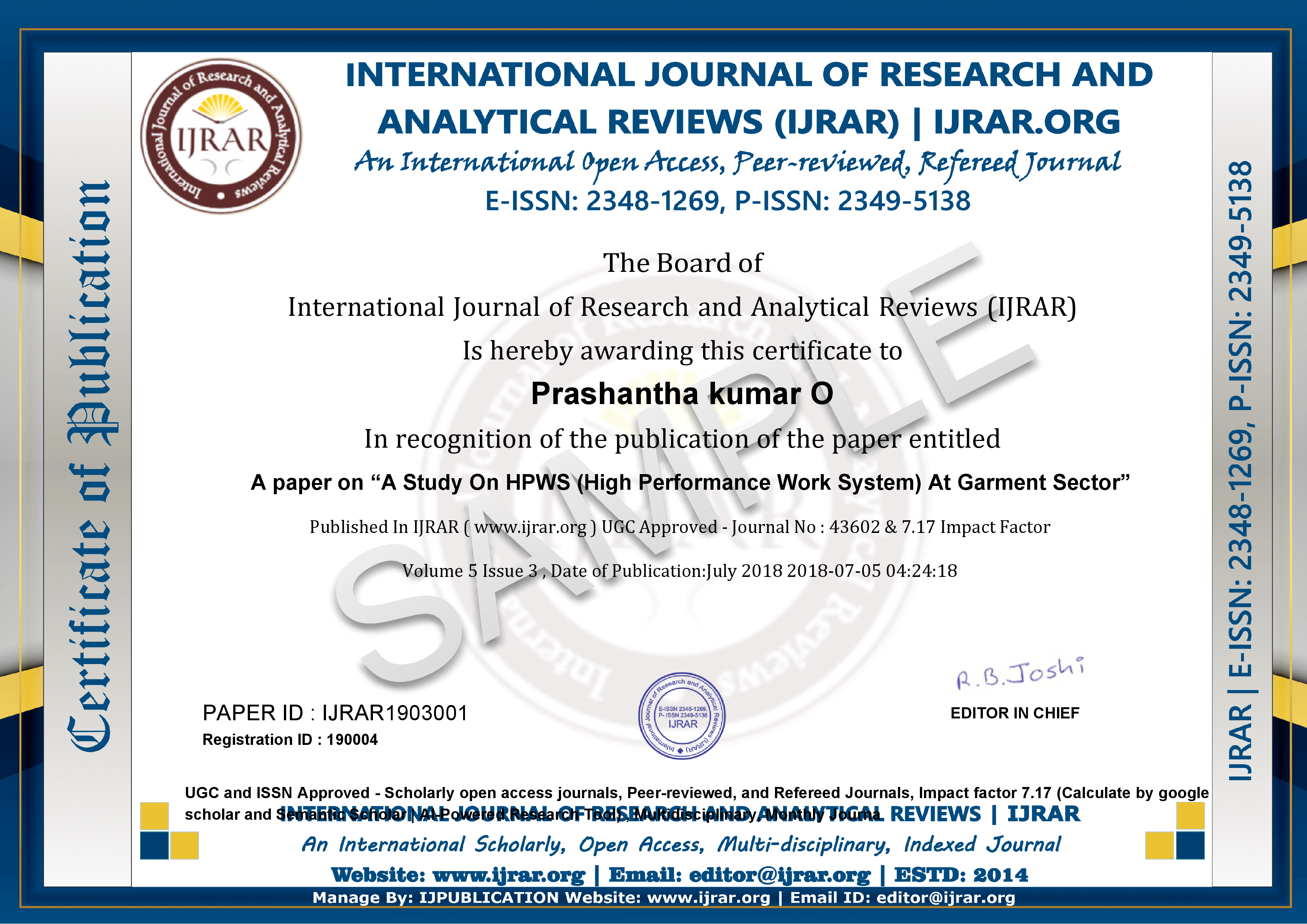
Indexing In Google Scholar, ResearcherID Thomson Reuters, Mendeley : reference manager, Academia.edu, arXiv.org, Research Gate, CiteSeerX, DocStoc, ISSUU, Scribd, and many more INTERNATIONAL JOURNAL OF RESEARCH AND ANALYTICAL REVIEWS (IJRAR) E-ISSN 2348-1269, P- ISSN 2349-5138 | Impact factor: 7.17 | ESTD Year: 2014 | UGC and ISSN Approved. | Provide DOI and Hard copy of Certificate. Scholarly open access journals, Peer-reviewed, and Refereed Journals, AI-Powered Research Tool , Multidisciplinary, Monthly, Indexing in all major database & Metadata, Citation Generator, Digital Object Identifier(DOI) Low Open Access Publication Charge 1570 INR for indian author & 59$ for foreign International author..
Subject Category : Multidisciplinary, Monthly scholarly open access journals
Call For Paper (Volume 13 | Issue 1 | Month- January 2026)Paper Title: Voices of Resistance and Sacrifice: Feminine Ethical Perspectives in the Mahabharata - Selected Women Characters
Publisher Journal Name: IJRAR, IJPUBLICATION
CrossRef DOI Member ID: 10.56975 Published Paper URL: http://ijrar.org/viewfull.php?&p_id=IJRAR1EHP001 Published Paper PDF: download.php?file=IJRAR1EHP001 Published Paper PDF: http://www.ijrar.org/papers/IJRAR1EHP001.pdf
Published Paper ID: - IJRAR1EHP001
Register Paper ID - 325517
Title: VOICES OF RESISTANCE AND SACRIFICE: FEMININE ETHICAL PERSPECTIVES IN THE MAHABHARATA - SELECTED WOMEN CHARACTERS
Author Name(s): Ariharan S
Publisher Journal name: IJRAR, IJPUBLICATION
DOI (Digital Object Identifier) :
Pubished in Volume: 12 | Issue: 4 | Year: December 2025
Volume: 12
Issue: 4
Pages: 1-9
Year: December 2025
Subject Area: Science and Technology
Author type: Indian Author
Downloads: 21
Draupadi, Kunti, Gandhari, and Satyavati are four central women of the Mahabharata introduce a distinctly "feminine" voice into the epic's moral universe. Each navigates complex dilemmas of dharma (duty/ethics) through her own experience of power, agency, and sacrifice. (Anggreni et al., 2020). Draupadi's polyandrous marriage and her public humiliation in the royal court spark questions of justice and patriarchal double standards. Kunti's secret motherhood (Karna) and lifelong devotion to her husband's lineage force her to balance maternal love with duty. (Nisha, 2023) Gandhari's unwavering commitment to her blind husband leads her to self-impose blindness, symbolising a unique perspective on righteous conduct amidst profound loss. Gandhari's self-imposed blindness and ultimate curse on Krishna exemplify how grief and loyalty can lead to a moral reckoning. (Parinitha & Lourdusamy, 2022) Satyavati's rise from humble origins, her use of Niyogi to produce heirs, and her political manoeuvring for the dynasty reveal the ethics of ambition and duty (Ethical and Philosophical Parallels of Artificial Intelligence (AI) in Hindu Mythology: The Mahabharat, 2024). Collectively, their narratives highlight the nuanced and often conflicting interpretations of dharma, moving beyond rigid codifications to encompass the spontaneous and intuitive grasp of ethical conduct, referred to as "Suksma dharma" (Black, 2022). Together, their narratives transcend conventional heroic ideals, offering a nuanced exploration of dharma from perspectives often marginalised within traditional epic discourse, and thereby enriching the epic's ethical landscape (Balaswamy, 2013) (Dhand, 2004). Drawing on Sanskrit texts and modern scholarship, we argue that these women expand the Mahabharata's moral discourse: they embody an ethic of care and relational justice that complements the epic's formal dharma codes. (Black, 2022) Their stories show that ideals of righteousness must accommodate female agency, suffering, and sacrifice - enriching the epic's vision of dharma beyond the male-dominated paradigm.
Licence: creative commons attribution 4.0
Creative Commons Attribution 4.0 and The Open Definition


Feminine, Ethics, Mahabharata, Dharma, Women, Parivarta
Creative Commons Attribution 4.0 and The Open Definition
Paper Title: The Death of the Author Revisited: Authorship in Hypertext and E-Literature
Publisher Journal Name: IJRAR, IJPUBLICATION
CrossRef DOI Member ID: 10.56975 Published Paper URL: http://ijrar.org/viewfull.php?&p_id=IJRAR1EHP002 Published Paper PDF: download.php?file=IJRAR1EHP002 Published Paper PDF: http://www.ijrar.org/papers/IJRAR1EHP002.pdf
Published Paper ID: - IJRAR1EHP002
Register Paper ID - 325518
Title: THE DEATH OF THE AUTHOR REVISITED: AUTHORSHIP IN HYPERTEXT AND E-LITERATURE
Author Name(s): Ariharan S
Publisher Journal name: IJRAR, IJPUBLICATION
DOI (Digital Object Identifier) :
Pubished in Volume: 12 | Issue: 4 | Year: December 2025
Volume: 12
Issue: 4
Pages: 10-18
Year: December 2025
Subject Area: Science and Technology
Author type: Indian Author
Downloads: 18
Licence: creative commons attribution 4.0
Creative Commons Attribution 4.0 and The Open Definition
Electronic Literature, Hypertext Fiction, Authorship, Roland Barthes, Michel Foucault, Reader-response, Ergodic Literature, Media Materiality, Distributed Authorship
Creative Commons Attribution 4.0 and The Open Definition
Paper Title: Narrating the Unspoken and Queer Women's Experience in K. Vaishali and Amruta Patil
Publisher Journal Name: IJRAR, IJPUBLICATION
CrossRef DOI Member ID: 10.56975 Published Paper URL: http://ijrar.org/viewfull.php?&p_id=IJRAR1EHP003 Published Paper PDF: download.php?file=IJRAR1EHP003 Published Paper PDF: http://www.ijrar.org/papers/IJRAR1EHP003.pdf
Published Paper ID: - IJRAR1EHP003
Register Paper ID - 325519
Title: NARRATING THE UNSPOKEN AND QUEER WOMEN'S EXPERIENCE IN K. VAISHALI AND AMRUTA PATIL
Author Name(s): Ariharan S
Publisher Journal name: IJRAR, IJPUBLICATION
DOI (Digital Object Identifier) :
Pubished in Volume: 12 | Issue: 4 | Year: December 2025
Volume: 12
Issue: 4
Pages: 19-32
Year: December 2025
Subject Area: Science and Technology
Author type: Indian Author
Downloads: 13
Contemporary Indian women writers - Amruta Patil in her graphic novel Kari (2008) and K. Vaishali in her memoir Homeless: Growing Up Lesbian and Dyslexic in India (2023) - give voice to lesbian and queer women's experiences that have long been culturally silenced. Situating these works within the history of queer literature in India and informed by queer theory, intersectionality, and feminist criticism, the paper explores how each author narrates the "unspoken." Kari uses visual allegory and non-linear storytelling to depict a queer woman's alienation and fluid identity in urban Bombay. Homeless, by contrast, employs a direct autobiographical voice to confront stigma around lesbianism, disability, caste, and mental health. A comparative analysis highlights differences of form (graphic novel vs. memoir), tone (coded symbolism vs. explicit confession), and intersectional focus (urban alienation vs. marginalised identity). Together, these texts mark a shift from subtle, coded narratives of lesbian life (as in Patil's earlier work) to unapologetic self-narration by queer women (as in Vaishali's recent memoir). They demonstrate how queer women are "reclaiming the silences" in Indian literature, expanding representation and challenging heteronormative discourse. This paper concludes that these narratives, through their distinct genres, contribute significantly to an evolving Indian queer women's literary tradition.
Licence: creative commons attribution 4.0
Creative Commons Attribution 4.0 and The Open Definition
Queer Women's Literature, India, Amruta Patil, K. Vaishali, Graphic Novel, Autobiography, Lesbian, Subjectivity, Silence, Intersectionality
Creative Commons Attribution 4.0 and The Open Definition
Paper Title: Voices of the Displaced: Diasporic Narratives and the Sri Lankan Civil Conflict
Publisher Journal Name: IJRAR, IJPUBLICATION
CrossRef DOI Member ID: 10.56975 Published Paper URL: http://ijrar.org/viewfull.php?&p_id=IJRAR1EHP004 Published Paper PDF: download.php?file=IJRAR1EHP004 Published Paper PDF: http://www.ijrar.org/papers/IJRAR1EHP004.pdf
Published Paper ID: - IJRAR1EHP004
Register Paper ID - 325520
Title: VOICES OF THE DISPLACED: DIASPORIC NARRATIVES AND THE SRI LANKAN CIVIL CONFLICT
Author Name(s): Arpita Roychowdhury
Publisher Journal name: IJRAR, IJPUBLICATION
DOI (Digital Object Identifier) :
Pubished in Volume: 12 | Issue: 4 | Year: December 2025
Volume: 12
Issue: 4
Pages: 33-51
Year: December 2025
Subject Area: Science and Technology
Author type: Indian Author
Downloads: 13
Sri Lanka's three-decade civil conflict spread more than a million citizens around the world and left those who stayed to deal with militarisation, land loss and communal suspicion. Ai investigates, in this article, how in four Anglophone novels - Anil's Ghost (2000), written by Michael Ondaatje; Funny Boy (1994), written by Shyam Selvadurai; Island of a Thousand Mirrors (2012) by Nayomi Munaweera, Joined with post-colonial theory (hybridity, "third space"), diaspora studies (trans-local memory, multiscale belonging) and narratology (focalisation, temporal disjunction), the study performs qualitative close reading which is triangulated with historical reports and secondary criticism. Analysis shows three convergent rupture-vectors: spatial, corporeal and temporal - through which exile is experienced. however, the novels diverge in their inflections of sexuality class and ecology. Formal techniques - mosaic montage, alternation between first person chapters, diary metalepsis, and ecological soundscapes - do more than ornament action; they recompense partiality and squares it in a plane. they execute epistemic interventions that undermine monolingual historiography and encourage readers to take perspectives in betwixt-and-between zones. Together, the texts serve as grassroots peace tools that chart the micro movements of sympathy and model new, hybrid futurities that institutional reconciliatory modes miss. It is argued in the article that Sri Lankan diasporic fiction with its preservation of micro-histories and facilitation of imaginative reconstruction of shattered selves provides essential knowledge for scholars of post-conflict societies, policy makers and practitioners concerned by the affect-centred approach to reconciliation.
Licence: creative commons attribution 4.0
Creative Commons Attribution 4.0 and The Open Definition
Sri Lankan diaspora; displacement; fragmented identity; post-colonial hybridity; trauma narrative; Anglophone fiction; peacebuilding; comparative literary analysis
Creative Commons Attribution 4.0 and The Open Definition
Paper Title: Neuroethological Interpretations of Animal Mind in Eliot's Practical Cats
Publisher Journal Name: IJRAR, IJPUBLICATION
CrossRef DOI Member ID: 10.56975 Published Paper URL: http://ijrar.org/viewfull.php?&p_id=IJRAR1EHP005 Published Paper PDF: download.php?file=IJRAR1EHP005 Published Paper PDF: http://www.ijrar.org/papers/IJRAR1EHP005.pdf
Published Paper ID: - IJRAR1EHP005
Register Paper ID - 325521
Title: NEUROETHOLOGICAL INTERPRETATIONS OF ANIMAL MIND IN ELIOT'S PRACTICAL CATS
Author Name(s): Deepika. I, Dr. Bairavi. B
Publisher Journal name: IJRAR, IJPUBLICATION
DOI (Digital Object Identifier) :
Pubished in Volume: 12 | Issue: 4 | Year: December 2025
Volume: 12
Issue: 4
Pages: 52-60
Year: December 2025
Subject Area: Science and Technology
Author type: Indian Author
Downloads: 13
This paper examines the convergence of neuroethology and cognitive literary theory in T. S. Eliot's Old Possum's Book of practical Cats, presenting a innovative interpretation of Eliot's poetic representations of behaviour and consciousness. This research uses a neuroethological framework and for augmenting this paper Lisa Zunshine's Theory of Mind (ToM), serves to provide how Eliot's poems engage readers to attribute the memory, intention, self-awareness to animal characters. This study focuses on the three poems "Macavity: The Mystery Cat", "Gus: The Theatre Cat", and "Skimbleshanks: The Railway Cat" from the Old Possum's Book of practical Cats where the focus tend to explore the feline characters. This study positions Eliot's cat poems as early experiments in representing nonhuman minds and this interdisciplinary approach offers new lens in neuroethological poetics of literary animals by merging neuroscientific understandings of feline behaviour with reader-centered cognitive literary approaches by illustrates the potential of poetry to act as a medium for imaginative interactions with nonhuman neuro-cognitive realms.
Licence: creative commons attribution 4.0
Creative Commons Attribution 4.0 and The Open Definition
Neuroethology, cognitive literary theory, feline characters, theory of mind (ToM), Non-human minds.
Creative Commons Attribution 4.0 and The Open Definition
Paper Title: Crossing Borders, Crossing Selves: A Comparative Reading of Migrant and Refugee Experiences in the Works of Khaled Hosseini and Bapsi Sidhwa
Publisher Journal Name: IJRAR, IJPUBLICATION
CrossRef DOI Member ID: 10.56975 Published Paper URL: http://ijrar.org/viewfull.php?&p_id=IJRAR1EHP006 Published Paper PDF: download.php?file=IJRAR1EHP006 Published Paper PDF: http://www.ijrar.org/papers/IJRAR1EHP006.pdf
Published Paper ID: - IJRAR1EHP006
Register Paper ID - 325522
Title: CROSSING BORDERS, CROSSING SELVES: A COMPARATIVE READING OF MIGRANT AND REFUGEE EXPERIENCES IN THE WORKS OF KHALED HOSSEINI AND BAPSI SIDHWA
Author Name(s): Dr Sreevidhya S
Publisher Journal name: IJRAR, IJPUBLICATION
DOI (Digital Object Identifier) :
Pubished in Volume: 12 | Issue: 4 | Year: December 2025
Volume: 12
Issue: 4
Pages: 61-66
Year: December 2025
Subject Area: Science and Technology
Author type: Indian Author
Downloads: 17
"The student who considers literature from a comparative point of view will find that, like the notions of period, current, and movement, the concept of genre offers an extremely fruitful field of investigation. In cultivating this branch of literary theory, the scholar must proceed historically as well as critically if he is to discover principles that make possible a systematic arrangement of his material". (Ulrich Weisstein, 1973, 99).
Licence: creative commons attribution 4.0
Creative Commons Attribution 4.0 and The Open Definition
Crossing Borders, Crossing Selves: A Comparative Reading of Migrant and Refugee Experiences in the Works of Khaled Hosseini and Bapsi Sidhwa
Creative Commons Attribution 4.0 and The Open Definition
Paper Title: Hazardous Estrangement of Racial Discrimination in Kathryn Stockett's The Help
Publisher Journal Name: IJRAR, IJPUBLICATION
CrossRef DOI Member ID: 10.56975 Published Paper URL: http://ijrar.org/viewfull.php?&p_id=IJRAR1EHP007 Published Paper PDF: download.php?file=IJRAR1EHP007 Published Paper PDF: http://www.ijrar.org/papers/IJRAR1EHP007.pdf
Published Paper ID: - IJRAR1EHP007
Register Paper ID - 325523
Title: HAZARDOUS ESTRANGEMENT OF RACIAL DISCRIMINATION IN KATHRYN STOCKETT'S THE HELP
Author Name(s): Dr. C. Usha Nandhini
Publisher Journal name: IJRAR, IJPUBLICATION
DOI (Digital Object Identifier) :
Pubished in Volume: 12 | Issue: 4 | Year: December 2025
Volume: 12
Issue: 4
Pages: 67-75
Year: December 2025
Subject Area: Science and Technology
Author type: Indian Author
Downloads: 13
Kathryn Stockett's The Help (2009) dramatizes the rigid racial hierarchy of 1960s Mississippi, depicting how Jim Crow-era discrimination creates a deeply dangerous estrangement between Black domestic workers and the white families they serve. This study examines the novel's portrayal of racial prejudice as a form of "hazardous estrangement" - enforced separation that inflicts physical and psychological harm. Drawing on recent literary analyses and historical context, we analyze key scenes and dialogue in The Help that illustrate segregation (Hilly Holbrook's bathroom initiative, racist insults, enforced isolation) and racial violence (forced bleach washes, outdoor punishment, KKK terror). We also consider how the novel's protagonists build trans-racial solidarity (Skeeter, Aibileen, and Minny's friendships and secret book project) to counteract this divide. A comparative note is made to Toni Morrison's Beloved (1987), where slavery's brutality likewise alienates African American families and communities. In sum, The Help highlights both the perils of racial estrangement and the fragile possibility of overcoming it through empathy and storytelling.
Licence: creative commons attribution 4.0
Creative Commons Attribution 4.0 and The Open Definition
Racial Discrimination; Segregation; Estrangement; Kathryn Stockett; The Help; Toni Morrison; Beloved; Jim Crow; Southern Literature.
Creative Commons Attribution 4.0 and The Open Definition
Paper Title: Microbial Metaphors: How Language Shapes our Understanding of Life
Publisher Journal Name: IJRAR, IJPUBLICATION
CrossRef DOI Member ID: 10.56975 Published Paper URL: http://ijrar.org/viewfull.php?&p_id=IJRAR1EHP008 Published Paper PDF: download.php?file=IJRAR1EHP008 Published Paper PDF: http://www.ijrar.org/papers/IJRAR1EHP008.pdf
Published Paper ID: - IJRAR1EHP008
Register Paper ID - 325524
Title: MICROBIAL METAPHORS: HOW LANGUAGE SHAPES OUR UNDERSTANDING OF LIFE
Author Name(s): Dr. H. Pallavi, Dr. Talanki Jeevan Kumar
Publisher Journal name: IJRAR, IJPUBLICATION
DOI (Digital Object Identifier) :
Pubished in Volume: 12 | Issue: 4 | Year: December 2025
Volume: 12
Issue: 4
Pages: 76-84
Year: December 2025
Subject Area: Science and Technology
Author type: Indian Author
Downloads: 13
Microbial metaphors are the figurative ways of characterizing the roles of microbes or germs which help people in understanding human life and in carrying out research. The microbial metaphors use everyday terms like 'war', 'ecosystem', 'factory', and 'social network' to explain complex microbiological processes in which human are involved. These metaphors shape the perception of life and distort how scientists and society think about microbes. This research paper examines how metaphorical language influences scientific reasoning, medical practice, and public perception of microbes. It makes an attempt to extend the argument that metaphors are not just decorative devices but rather cognitive tools that shape how scientists and society conceptualize the microbial world. It even tries to trace this linguistic evolution - from the neutral 'animalcules' of early microscopy to the 'war on microbes' of the antibiotic era, and to recent ecological and technological metaphors such as 'microbes as ecosystems,' 'social networks,' and 'factories.' Drawing on conceptual metaphor theory and the philosophy of science, it demonstrates how metaphors guide research, influence ethics, and frame public understanding. The study concludes that awareness of metaphorical diversity is essential in order to practice responsible and inclusive scientific communication.
Licence: creative commons attribution 4.0
Creative Commons Attribution 4.0 and The Open Definition
Microbial metaphors, cognitive, animalcules, war on microbes, ecosystem
Creative Commons Attribution 4.0 and The Open Definition
Paper Title: AI TOOLS FOR TEACHING LANGUAGE AND LITERATURE
Publisher Journal Name: IJRAR, IJPUBLICATION
CrossRef DOI Member ID: 10.56975 Published Paper URL: http://ijrar.org/viewfull.php?&p_id=IJRAR1EHP009 Published Paper PDF: download.php?file=IJRAR1EHP009 Published Paper PDF: http://www.ijrar.org/papers/IJRAR1EHP009.pdf
Published Paper ID: - IJRAR1EHP009
Register Paper ID - 325525
Title: AI TOOLS FOR TEACHING LANGUAGE AND LITERATURE
Author Name(s): Dr. S. Sangeetha, Ms. N. Rithika
Publisher Journal name: IJRAR, IJPUBLICATION
DOI (Digital Object Identifier) :
Pubished in Volume: 12 | Issue: 4 | Year: December 2025
Volume: 12
Issue: 4
Pages: 85-102
Year: December 2025
Subject Area: Science and Technology
Author type: Indian Author
Downloads: 13
The increasingly visible role of Artificial Intelligence (AI) in language and literature classrooms has brought about a gradual shift in the manner of learning. Instead of replacing the teacher in the language and literature classrooms, AI-based applications are increasingly becoming learning assistants that address individual learning needs, motivate students to participate in learning activities, and provide easier access to learning materials. This paper explores a number of applications of AI that are increasingly finding their application in language and literature teaching and learning, with emphasis on their key features, applications, benefits, and challenges. It is revealed in this study that applications with features of real-time feedback, adaptive learning paths, and individualized support for literature learning have brought about a positive shift in learning and teaching practices in language and literature classrooms. This paper also focuses on the role of AI applications in developing language skills like grammar, learning writing skills, understanding texts, as well as interactive approaches to texts. At the same time, it also explores the challenges of data privacy, affordability, unequal accessibility, and technological overdependency that are increasingly becoming issues of prime importance with respect to AI applications. It is evident that the application of AI-based applications would mean significant development opportunities in language and literature learning.
Licence: creative commons attribution 4.0
Creative Commons Attribution 4.0 and The Open Definition
AI TOOLS FOR TEACHING LANGUAGE AND LITERATURE
Creative Commons Attribution 4.0 and The Open Definition
Paper Title: A Literary Perspective on Guerrilla Gardening as a Tool for Regreening the Planet
Publisher Journal Name: IJRAR, IJPUBLICATION
CrossRef DOI Member ID: 10.56975 Published Paper URL: http://ijrar.org/viewfull.php?&p_id=IJRAR1EHP010 Published Paper PDF: download.php?file=IJRAR1EHP010 Published Paper PDF: http://www.ijrar.org/papers/IJRAR1EHP010.pdf
Published Paper ID: - IJRAR1EHP010
Register Paper ID - 325552
Title: A LITERARY PERSPECTIVE ON GUERRILLA GARDENING AS A TOOL FOR REGREENING THE PLANET
Author Name(s): Dr. S.S. Uma Sundara Sood
Publisher Journal name: IJRAR, IJPUBLICATION
DOI (Digital Object Identifier) :
Pubished in Volume: 12 | Issue: 4 | Year: December 2025
Volume: 12
Issue: 4
Pages: 103-107
Year: December 2025
Subject Area: Science and Technology
Author type: Indian Author
Downloads: 15
Guerrilla gardening has emerged as a grassroots ecological practice that challenges urban neglect, environmental degradation, and unequal access to green spaces through unauthorized cultivation and rewilding. This paper offers a literary perspective on guerrilla gardening as a tool for regreening the planet, situating the practice within the theoretical framework of ecocriticism. By examining literary representations of environmental activism, the study highlights the role of narrative in cultivating green consciousness and sustainable hope. Eleanor Catton's Birnam Wood is taken as a central contemporary text to explore how guerrilla gardening functions as ecological resistance, interrogating issues of land ownership, power structures, capitalism, and ethical responsibility toward nature. Through close textual analysis and ecocritical interpretation, the paper argues that literature not only reflects ecological concerns but also actively participates in shaping environmental awareness and motivating collective ecological action.
Licence: creative commons attribution 4.0
Creative Commons Attribution 4.0 and The Open Definition
Ecocriticism, Guerrilla Gardening, Regreening the Planet, Environmental Resistance.
Creative Commons Attribution 4.0 and The Open Definition
Paper Title: Rediscovering Self and Black Identity in Paule Marshall's Praise song for the Widow
Publisher Journal Name: IJRAR, IJPUBLICATION
CrossRef DOI Member ID: 10.56975 Published Paper URL: http://ijrar.org/viewfull.php?&p_id=IJRAR1EHP011 Published Paper PDF: download.php?file=IJRAR1EHP011 Published Paper PDF: http://www.ijrar.org/papers/IJRAR1EHP011.pdf
Published Paper ID: - IJRAR1EHP011
Register Paper ID - 325553
Title: REDISCOVERING SELF AND BLACK IDENTITY IN PAULE MARSHALL'S PRAISE SONG FOR THE WIDOW
Author Name(s): Dr. T. Ezhilarasi
Publisher Journal name: IJRAR, IJPUBLICATION
DOI (Digital Object Identifier) :
Pubished in Volume: 12 | Issue: 4 | Year: December 2025
Volume: 12
Issue: 4
Pages: 108-116
Year: December 2025
Subject Area: Science and Technology
Author type: Indian Author
Downloads: 13
This paper examines the self and identity among Afro-American women in Paule Marshall's Praisesong for the Widow. It is a novel that emphasises the search for identity that Marshall herself experienced. Additionally, it explores the significance of identification, the issue of self and identity in her novel, and the connection between personal and societal Black identity among African-American women. Avey Johnson, 64-year-old protagonist, is an example of a black woman who is still capable of using myths, rituals, and dances to translate her own history into cultural metaphor. Avey suggests that African Americans need to connect those elements of their black ancestry that are psychologically uplifting by using historical, personal, and cultural analogies. Here, myths, dances, traditions, and rituals have preserved the remnants of African cultures.
Licence: creative commons attribution 4.0
Creative Commons Attribution 4.0 and The Open Definition
Identity, Woman, Black, Self, Past, Memory
Creative Commons Attribution 4.0 and The Open Definition
Paper Title: The Misanthropic Vision of Humanity in Jonathan Swift's Gulliver's Travels
Publisher Journal Name: IJRAR, IJPUBLICATION
CrossRef DOI Member ID: 10.56975 Published Paper URL: http://ijrar.org/viewfull.php?&p_id=IJRAR1EHP012 Published Paper PDF: download.php?file=IJRAR1EHP012 Published Paper PDF: http://www.ijrar.org/papers/IJRAR1EHP012.pdf
Published Paper ID: - IJRAR1EHP012
Register Paper ID - 325554
Title: THE MISANTHROPIC VISION OF HUMANITY IN JONATHAN SWIFT'S GULLIVER'S TRAVELS
Author Name(s): Indhumathi M, Dr. P. Rajini
Publisher Journal name: IJRAR, IJPUBLICATION
DOI (Digital Object Identifier) :
Pubished in Volume: 12 | Issue: 4 | Year: December 2025
Volume: 12
Issue: 4
Pages: 117-128
Year: December 2025
Subject Area: Science and Technology
Author type: Indian Author
Downloads: 13
Gulliver, Travels (1726) by Jonathan Swift as a sustained satire, which eventually comes out as a highly misanthropic view of humanity. We introduce Swift as an inheritor of the Augustan school of satire and conceive of misanthropy as an aversion or repulsion to human beings. The narrative voice and the approach to satire used by Swift, i.e. through irony, parody, and inversion are characterized. We thus follow the reduction of human greatness in all these journeys: in Lilliput, we have small politics and small pride being sat upon; in Brobdingnag we have little people, little human beings, being scorned and reproved; in Laputa and Balnibarbi, we have abstract rationalism and science, being both ridiculed and condemned; and in the Land of the Houyhnhnms, we have human beings, human beings. In the final discussion we deal with some essential discussions on whether Swift is writing with a tone of utter hatred or of moral reform. Other critics (e.g. Rana, Rawson, Nichols) see the voice of Swift distinct to that of Gulliver raving, and the satirist seeks instead to divert the world and not to vex it. Swift has his contradictions brought to light by others in letters to affirm that he was not a misanthrope regardless of his venom. We are proposing that, whether we interpret it or not, Swift is employing exaggeration to speak the truth about the pride, corruption, irrationality and moral decadency of people. The satire progressively becomes darker reaching a peak in the last of these journeys: according to Carey, this is where Swift depicts human nature as becoming most explicit and one of his most damaging satire. Overall, Gulliver's Travels by Swift makes the reader deal with the most terrible aspects of human nature and the hybrid of satire and misanthropy difficulties that are rather uneasy to accept.
Licence: creative commons attribution 4.0
Creative Commons Attribution 4.0 and The Open Definition
Misanthropy, Satire, Jonathan Swift, Gulliver's Travels, Human Nature, Enlightenment.
Creative Commons Attribution 4.0 and The Open Definition